
We are developing what we call an open door towards AGI.
Disclaimer. AGI, or Artificial General Intelligence, is not well defined. If you’ve never heard those words, you can summarize AGI as “the intelligence of a machine that could successfully perform any intellectual task that a human being can” (Wikipedia, article on Artificial General Intelligence, retrieved on the 6th of April 2019). A pretty vague definition. We are not aiming at simulating or mimicking the human brain — nor any brain for that matter. We believe that brains are extremely complex and that we are just starting to understand them.
An open door towards AGI
First, we have a different and basic definition of intelligence:
Is intelligent any system that can autonomously change its internal understanding/representation of its outside world.
There are some subtleties (and flaws!) in this definition, but let’s focus on the essentials and be pragmatic. We call intelligent any system that could in principle wipe out what it has learnt or been programmed to be or do. Of course, the idea is not to have a system that randomly replaces chunks of its internal memory, but a system that “cautiously” decides to replace parts — or even all — of what it has learnt or been programmed to be or do.
Second, we claim we can construct such a system. But not overnight. It is taking some time, but we’ll get there.
Roadmap
Here is an (outdated) roadmap of how we plan to build this open door to AGI. We were overly optimistic, but the roadmap remains accurate about our future progression.
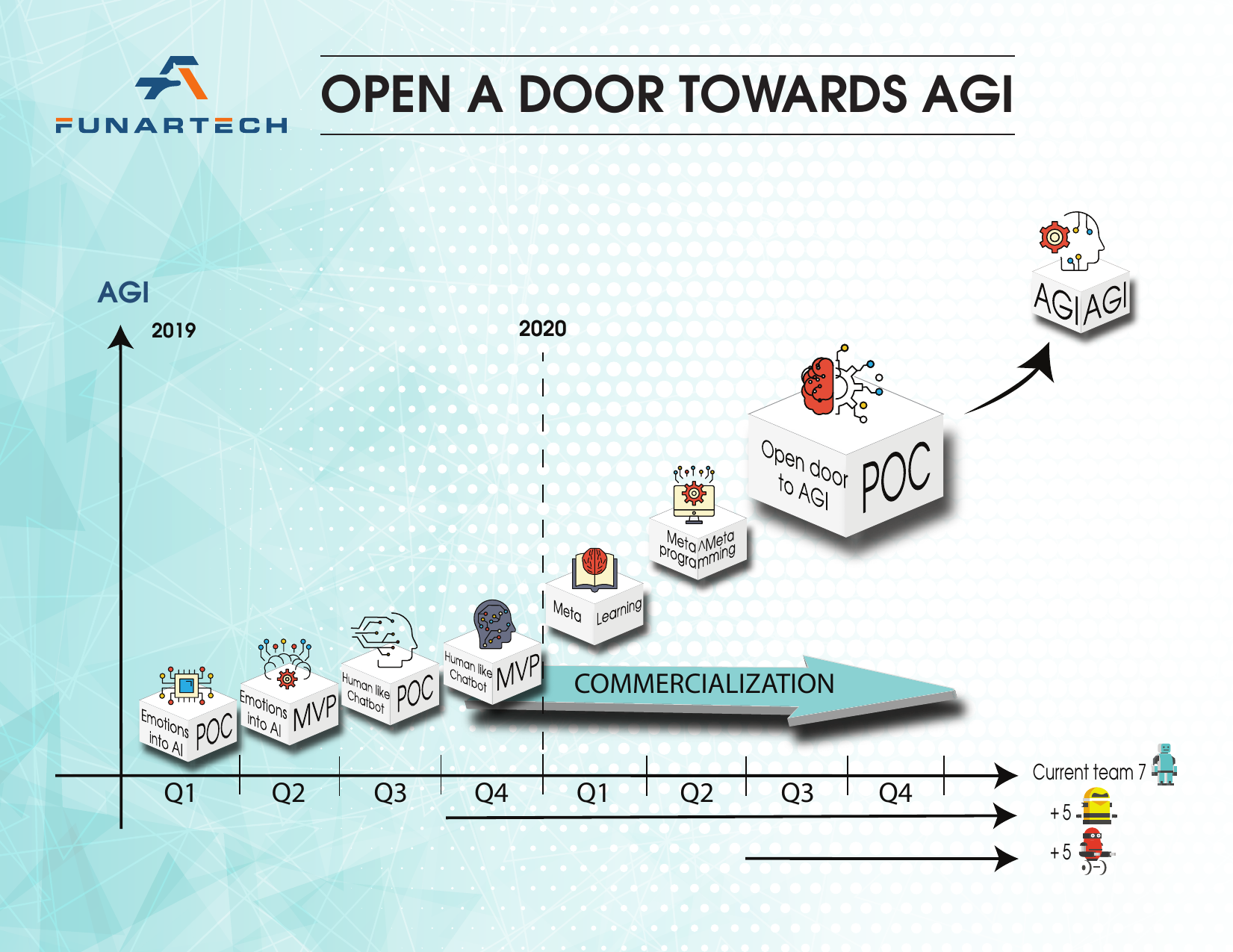
We started by injecting emotions into chatbots. Our first chatbot prototype, Philia, is a work in progress.
On Saturday the 30th of March 2019, we publicly presented our proof of concept at ConcordAI Finale — Far Into the Future: Implications of a World Run by AI. You can learn more about this story: it’s a nice story with a happy ending.
The next step is to transform this POC into an MVP (Minimum Viable Product). Stay tuned.